
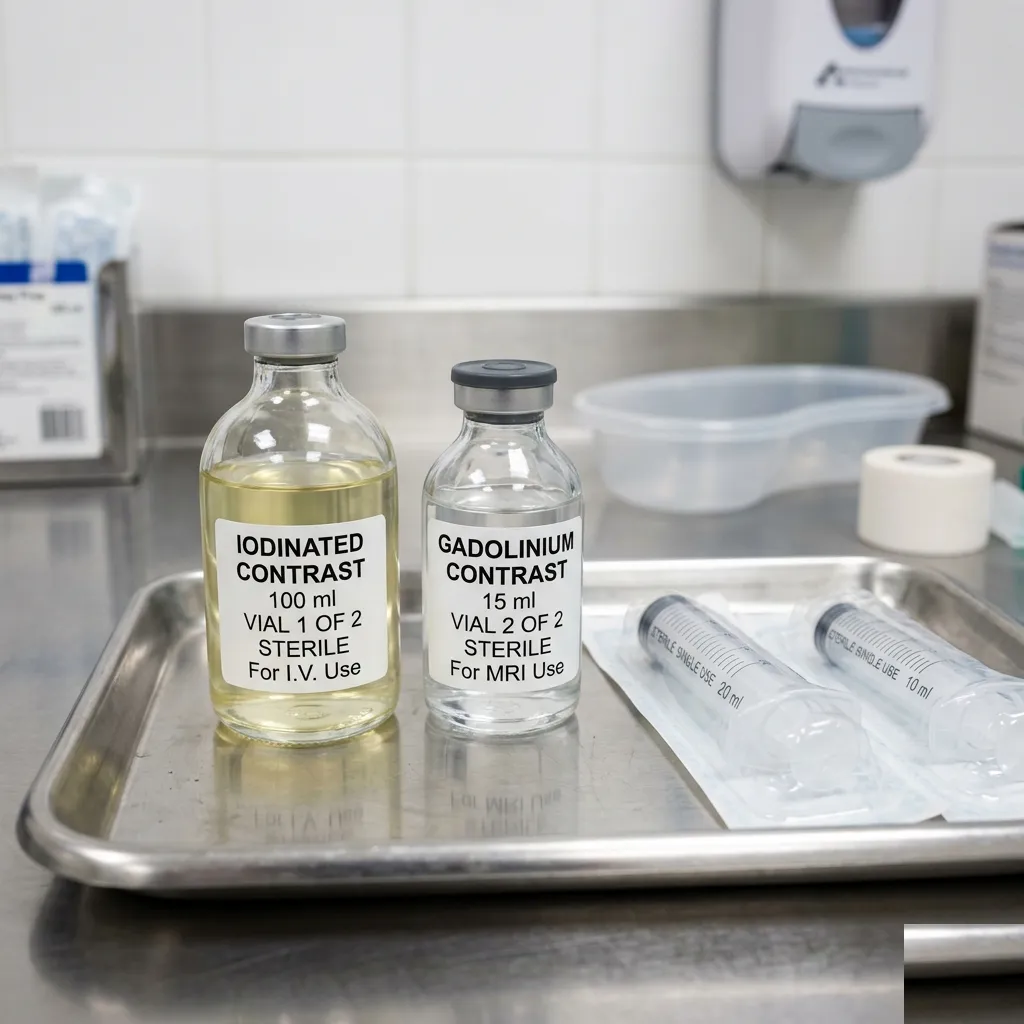
Contrast helps certain tissues, blood vessels, or areas of disease stand out more clearly. It is not automatically needed for every CT or MRI, and the two types used most often are not the same.
Iodine-based contrast for CT and some X-ray examinations
Iodine-based contrast may be injected into a vein during CT, angiography, or fluoroscopy. It can make blood vessels and organs easier to assess.
As it enters, you may feel warmth through your body, notice a metallic taste, or briefly feel as though you have passed urine. These sensations usually settle quickly and do not, by themselves, mean you are having an allergic-like reaction.
Gadolinium-based contrast for MRI
Gadolinium-based contrast changes the way some tissues appear on MRI. It can help show inflammation, blood vessels, infection, tumours, and other changes, depending on the examination.
Many people only notice coolness or pressure at the injection site. It does not usually cause the same warm flush as CT contrast.
Fasting and kidney tests are not the same for everyone
Some centers ask patients to fast before a contrast examination, while others do not for routine intravenous contrast. The instruction may also depend on the body part being scanned, whether sedation is planned, and the center's protocol.
A creatinine or eGFR blood test may be requested when there are kidney risk factors, known kidney disease, or a local policy that requires one. It is not a universal requirement for every patient.
Follow the instruction given for your particular scan. If none was provided, ask the center rather than fasting or arranging a blood test on your own.
Reactions and the history that matters
Most people receive contrast without a serious problem. Tell the team if you have:
- had a previous reaction to the same class of contrast;
- kidney disease, dialysis, or a kidney transplant;
- severe asthma or multiple serious allergies;
- a possibility of pregnancy; or
- an illness or medication the center has asked about.
A previous contrast reaction may change the contrast used, the setting of the scan, or whether premedication is considered. Premedication can reduce some reactions but cannot prevent every one.
Tell staff immediately if you develop widespread hives, facial or throat swelling, breathing difficulty, or feel faint during or after the injection.
The bottom line
Iodine contrast is mainly used with CT and X-ray based examinations. Gadolinium contrast is used with MRI. The preparation and safety checks depend on the contrast, your health history, and the scan being performed.