
RadFAQS
Scan GuidesDictionaryFind a CenterTalk to a Radiographer
Find/Book
HomeScan GuidesDictionaryFind a CenterTalk to a RadiographerBooking Follow-Up
RadFAQS

Nigeria's radiology directory - helping patients find listed diagnostic centers, understand their scans, and take control of their health.

Modalities

  • CT Scan
  • MRI
  • DEXA
  • X-ray
  • Ultrasound
  • Fluoroscopy
  • Mammography
  • Nuclear Medicine
  • Interventional Radiology
  • Radiotherapy

Platform

  • Find/Book a Scan
  • Talk to a Radiographer
  • Booking Follow-Up
  • Volunteer

Portals

  • Center Login

Stay in the Know

Get updates on new centers, health tips, and platform news.

support@RadFAQS.comWhatsApp Us
© 2026 RadFAQS. All rights reserved.
Privacy PolicyTerms of UseRefund PolicyAbout
Back to Articles
Before Your Scan

MRI Claustrophobia: What It Feels Like and How People Get Through It

SM
Written by Sangodoyin Maryam, B.Sc Radiography
·
Medically reviewed by Olusegun Samuel Faith, M.Sc (Medical Imaging), MPH, PgDip (MRI)· Last reviewed 20 May 2026
MRI Claustrophobia: What It Feels Like and How People Get Through It

About one in ten people who walk into an MRI room struggle with the tube. You are not alone, and the team has seen it many times before.

What actually triggers it

Claustrophobia in MRI is rarely about the small space alone. It is usually a mix of things:

  • The narrow tube around your face
  • The loud, repetitive knocking of the magnet
  • The duration, often 20 to 45 minutes
  • The sense of being unable to move freely
  • Not knowing how to stop the scan if you need to

Once you understand the triggers, several of them become manageable.

What actually works

Different things work for different people. Most centres are familiar with all of these:

  • Wear an eye-mask or simply keep your eyes closed from the moment you lie down
  • Ask for music or bring a familiar playlist through the headphones
  • Lie feet-first if the scan allows it, so your head stays nearer the open end
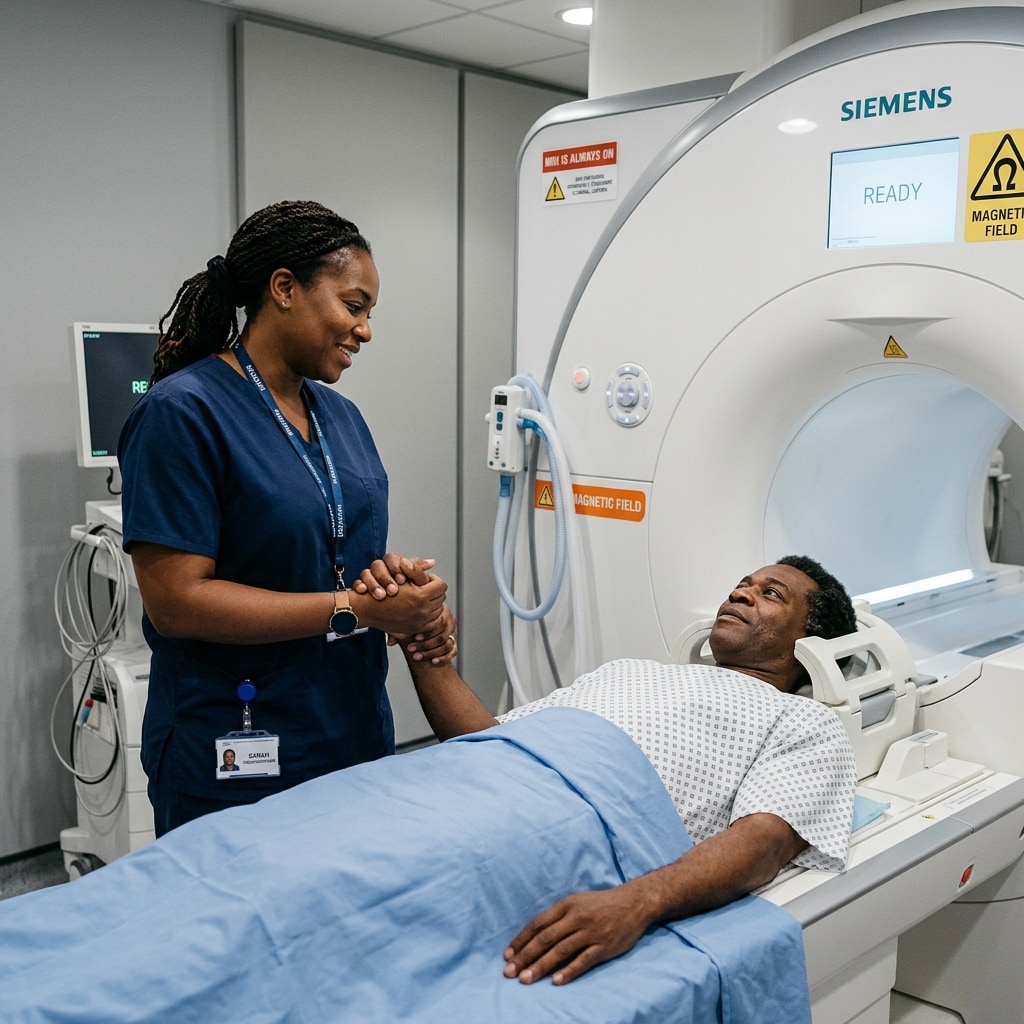
  • Ask the radiographer to pause and pull you out at any point. The table moves in seconds.
  • Bring a trusted person who can sit next to the scanner during the scan
  • If you know you struggle, ask your doctor about a mild sedative before the appointment

None of these is unusual. The team would rather build the scan around your needs than start over halfway through.

The breathing technique

One technique tends to help when nothing else is in reach. Breathe in slowly through your nose for four counts. Breathe out through your mouth for six counts. Repeat.

The slow out-breath signals your nervous system to settle, and your heart rate begins to drop within a minute. It is the same principle behind most anxiety breathing exercises, and it works inside the bore.

When to ask for an open MRI instead

If closed MRI feels impossible even with these techniques, an open MRI may be a better starting point. Most open scanners are lower field strength, so the trade-off is image detail. Open MRI is fine for many musculoskeletal scans but less suited to cardiac, prostate, or fine neurological work.

A conversation with your doctor and the centre will sort out whether your specific scan can be done that way.

What not to do

Do not tough it out silently. A panic attack mid-scan blurs the images, and the whole sequence often has to be repeated. The team would much rather pause the scan for 30 seconds than restart from the beginning.

Press the alert button. Talk through the intercom. Tell the radiographer how you are doing. That is what they are there for.

A practical close

Claustrophobia is a normal physiological response, not a weakness. The centres that do MRI every day are well-practised at managing it. Walk in expecting to need a strategy, not expecting to fail.

Radiology education only

RadFAQS explains radiology terms, scan preparation, and what patients commonly experience. It is not a diagnosis, treatment plan, or replacement for your referring doctor, radiologist, or care team. RadFAQS does not monitor this site for emergencies and cannot respond in real time. If symptoms are severe, worsening, or urgent, do not wait for a reply here — contact a healthcare professional or emergency service immediately.

Related FAQ guides

mri

Abdomen MRI

An Abdomen MRI is a highly specialized scan focusing on the major organs inside your belly. It uses strong magnetic fields and radio waves to provide detailed images of your liver, kidneys, pancreas, spleen, and bile ducts.

mri

Adrenal MRI

An Adrenal MRI is a focused scan of the small glands that sit above each kidney. It is most often used to characterise a mass found unexpectedly on another scan, and to tell harmless adenomas apart from lesions that need further attention.

mri

Ankle and Foot MRI

An Ankle and Foot MRI is a specialized scan focusing on the complex network of bones, ligaments, and tendons that support your body weight. It is highly effective for investigating persistent pain after a sprain, chronic heel pain, or hidden stress fractures.

mri

Brachial Plexus MRI

A Brachial Plexus MRI examines the network of nerves running from the neck into the shoulder and arm. It is the best scan for investigating arm weakness, numbness, or paralysis following birth injury, road accidents, shoulder trauma, or nerve compression.

Related dictionary terms

Procedure

MRI

MRI uses magnets and radio waves to create detailed images, especially of the brain, spine, joints, and soft tissues.

Term

Radiograph

A radiograph is the formal name for an X-ray image.