
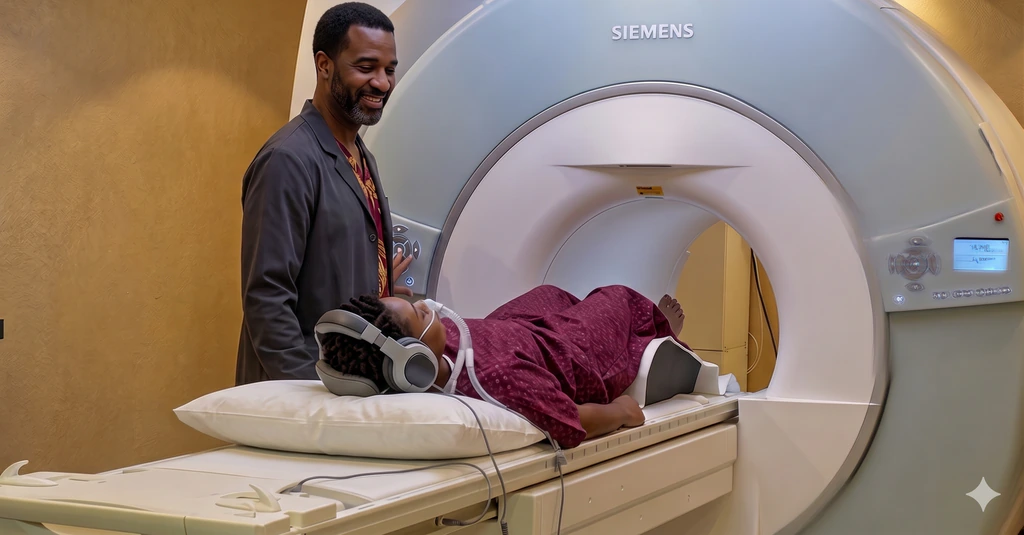
MRI stands for Magnetic Resonance Imaging. It uses strong magnets and radio waves to create detailed pictures, especially of soft tissues.
That is why doctors often prefer it for questions involving the brain, spine, joints, muscles, ligaments, and many internal organs.
What MRI is especially good at
MRI shines when the concern involves:
- The brain and spinal cord
- Ligament or tendon injury
- Disc problems
- Joint cartilage
- Pelvic organs
- Some tumors and inflammatory conditions
It is often chosen because it sees soft tissue detail better than CT or X-ray.
Why it feels different from other scans
MRI takes longer, the machine is louder, and the space can feel more enclosed. Those three things explain most of the anxiety around it.
The scan is painless, but staying still matters. Movement can blur the images and make the study less useful.
What MRI is not
MRI does not use radiation. That surprises a lot of people.
It is also not always the best first test. In an emergency, CT may be chosen first because it is faster. MRI is often used when the team needs more detail after that.
Who needs extra screening before MRI
Before the scan, the team may ask about:
- Metal implants
- Pacemakers
- Past surgeries
- Claustrophobia
- Kidney problems if contrast is planned
Those questions are about safety and image quality, not bureaucracy.
The bottom line
MRI is the detail specialist. It is often chosen when the body part is complicated, the tissue question is subtle, or the team needs a more precise answer than other scans can provide.