
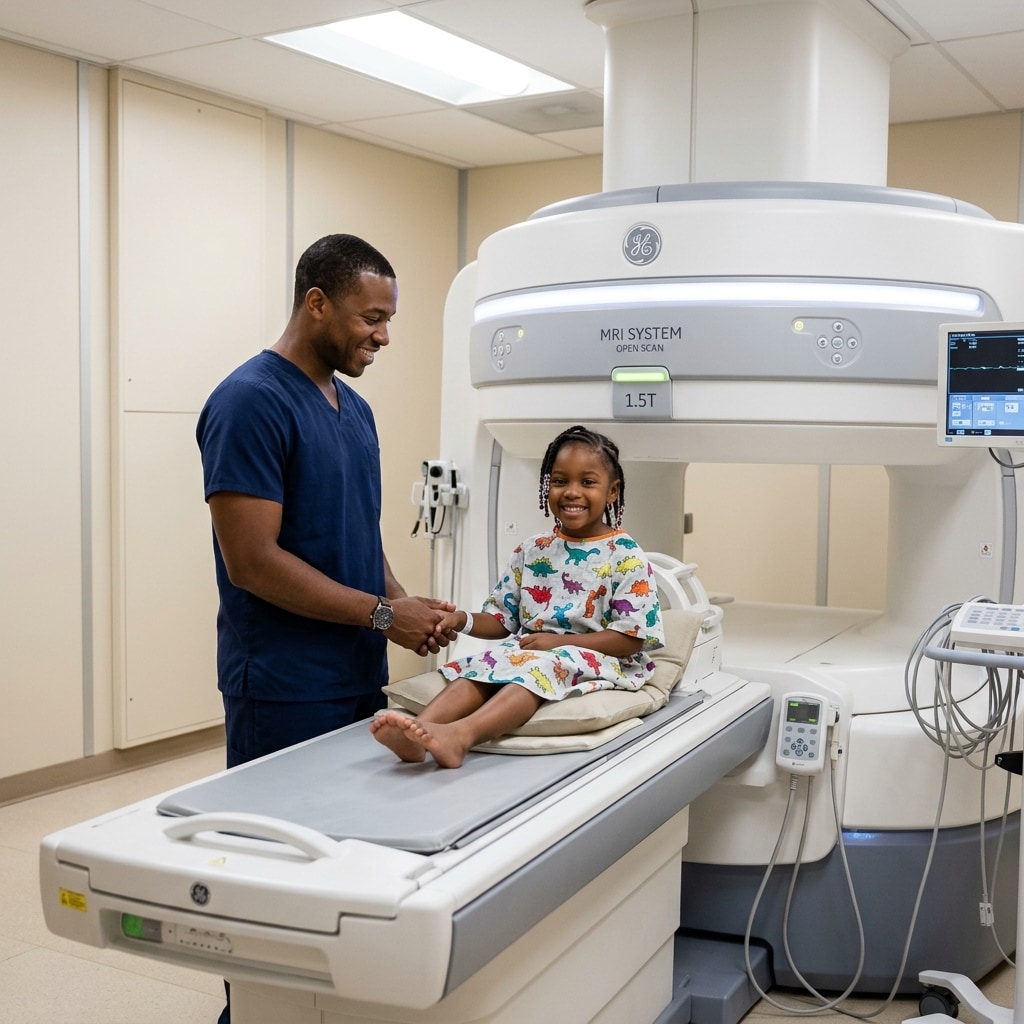
The tunnel is the part that scares people. For some, it is enough to skip the scan entirely. Open MRI exists for exactly that reason, but it is not always the right answer.
What each one looks like
A closed MRI is the familiar tube. You lie on a table that slides into a long cylinder, and the magnet surrounds you on all sides.
An open MRI is shaped more like a sandwich. The magnet sits above and below you, with two open sides at eye level. You can see the room. Someone can stand next to you.
Why most MRIs are closed
The strongest magnets need a tunnel design. A uniform magnetic field is easier to create inside a closed bore. That is why the 1.5T and 3T scanners most centers rely on are almost always closed.
Higher field strength means sharper images, faster scans, and more reliable answers for tricky questions.
What open MRI is genuinely good for
Open MRI earns its place in several situations:
- General musculoskeletal scans like knee or shoulder
- People who have struggled with closed MRI before
- Very large or obese patients who simply do not fit in a standard bore
- Child scans where a parent needs to be visible and reachable
- Breastfeeding mothers who need to stay close to a baby between sequences
For these, the open design can be the difference between a completed scan and a cancelled one.
What open MRI is not great for
Most open MRI scanners are low-field, somewhere between 0.35T and 1.0T. That changes what they can do well.
Open MRI tends to struggle with:
- Cardiac MRI
- Prostate MRI
- Very fine joint detail, like small wrist ligaments or cartilage
- MR angiography of small vessels
- Brain scans where subtle lesions matter
Scans also take longer on a low-field machine, and you may need to lie still for more time, not less.
What is available in Nigeria
Closed MRI is the standard across the country. A handful of private centers in Lagos and Abuja have open MRI scanners, but availability is patchy and the field strengths vary widely.
Two open scanners in the same city can produce very different images depending on whether they run at 0.35T or 1.0T.
How to ask the right question
If you are considering open MRI, do not stop at "do you have one?" Ask the center directly:
- Is your open MRI high-field or low-field?
- What Tesla strength does it run at?
- Is it suitable for the specific scan my doctor ordered?
A good center will answer plainly. If the answer is vague, that itself tells you something.
The bottom line
Open MRI is a real solution for real problems. It is not a worse version of closed MRI; it is a different tool with different strengths. The right choice depends on your body, your fears, and the question your doctor needs answered. Ask the center both questions before you book.