
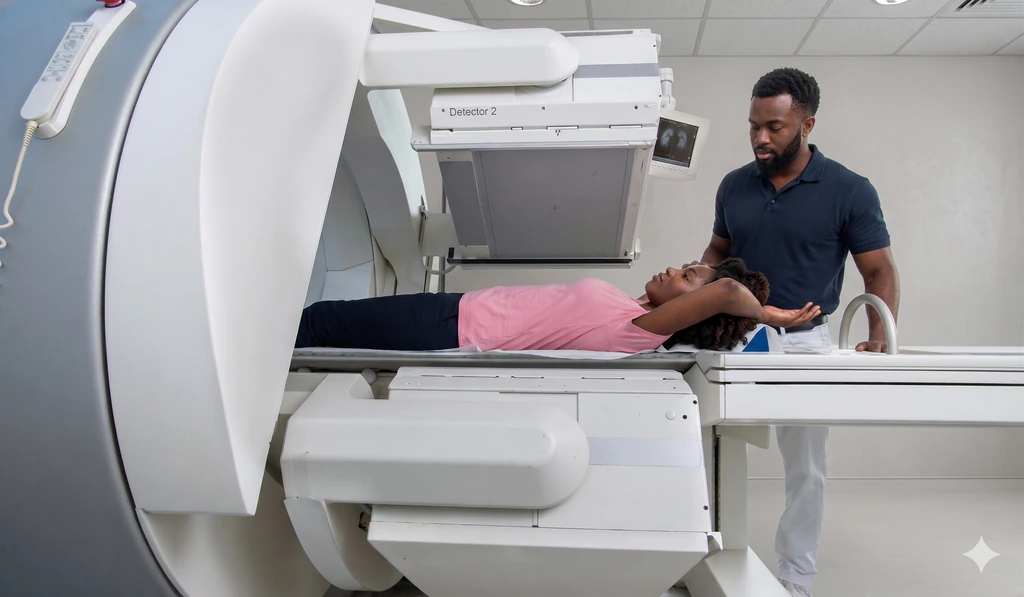
Nuclear medicine can feel mysterious because it works differently from most other scans.
Instead of mainly showing anatomy, it often shows function. A small radioactive tracer is used so doctors can see how a specific tissue or organ is behaving.
What that means in plain language
A nuclear medicine study may help answer questions like:
- Is this bone area unusually active?
- Is the thyroid overactive or underactive?
- Is heart muscle getting enough blood?
- Is this cancer spreading or responding to treatment?
The scan is less about shape alone and more about activity.
Common examples
Depending on the center, nuclear medicine may include:
- Bone scans
- Thyroid scans
- Renal scans
- Cardiac perfusion scans
- PET-CT
PET-CT is probably the most widely recognized example, but it sits within a bigger family of functional imaging tests.
Why doctors order it
Sometimes CT or MRI shows a structure but cannot fully answer what that structure is doing.
Nuclear medicine adds another layer. It can help show whether tissue is metabolically active, inflamed, healing, blocked, or suspicious.
What patients often worry about
The word "radioactive" sounds alarming. That is understandable.
But these studies are performed in controlled medical settings using tracers chosen for diagnostic use. The team explains any preparation, timing, and safety instructions based on the exact test.
The bottom line
Nuclear medicine is a functional imaging category. It may look unusual compared with ordinary scans, but it becomes extremely powerful when the key question is about activity, not just appearance.