
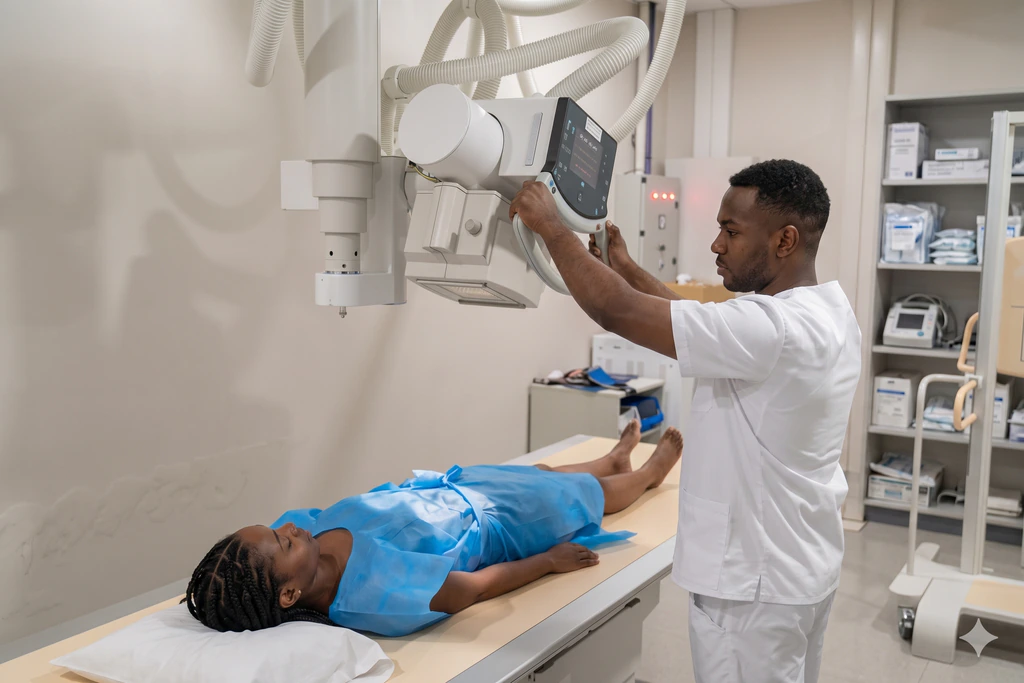
People often talk about X-rays as if they are the most basic scan and therefore the least important. That is not really true.
An X-ray is simple in the best sense of the word. It is fast, widely available, and often the right first test when a doctor needs an answer quickly.
What X-rays show well
X-rays are especially useful for:
- Broken bones
- Joint dislocations
- Arthritis changes
- Chest infections
- Certain causes of abdominal blockage
They are good at showing differences in density. Bone shows up clearly. Air-filled lungs also create patterns doctors can interpret well.
When an X-ray may be the first choice
Doctors often start with an X-ray when the question is straightforward.
For example:
- "Did this person fracture a bone?"
- "Does this chest pain look related to the lungs?"
- "Is there a lot of stool or bowel swelling?"
That does not mean the doctor is being cheap or dismissive. It often means an X-ray is the quickest reasonable place to begin.
What X-rays do not do as well
X-rays are not the best tool for every problem.
They are less useful when the real question involves:
- Fine detail inside the brain
- Ligament or tendon injuries
- Small soft tissue masses
- Complex organ problems in the abdomen
That is where CT, MRI, or ultrasound may do a better job.
Why they still matter
Part of good medicine is choosing the right level of imaging instead of jumping to the fanciest option every time.
An X-ray can answer an important question in minutes. If it does, that saves time, money, and unnecessary radiation or complexity from more advanced scans.
The bottom line
X-rays are not outdated. They are targeted.
If your doctor orders one first, it usually means they are starting with a test that is quick, practical, and often very good at answering the first question that matters.