
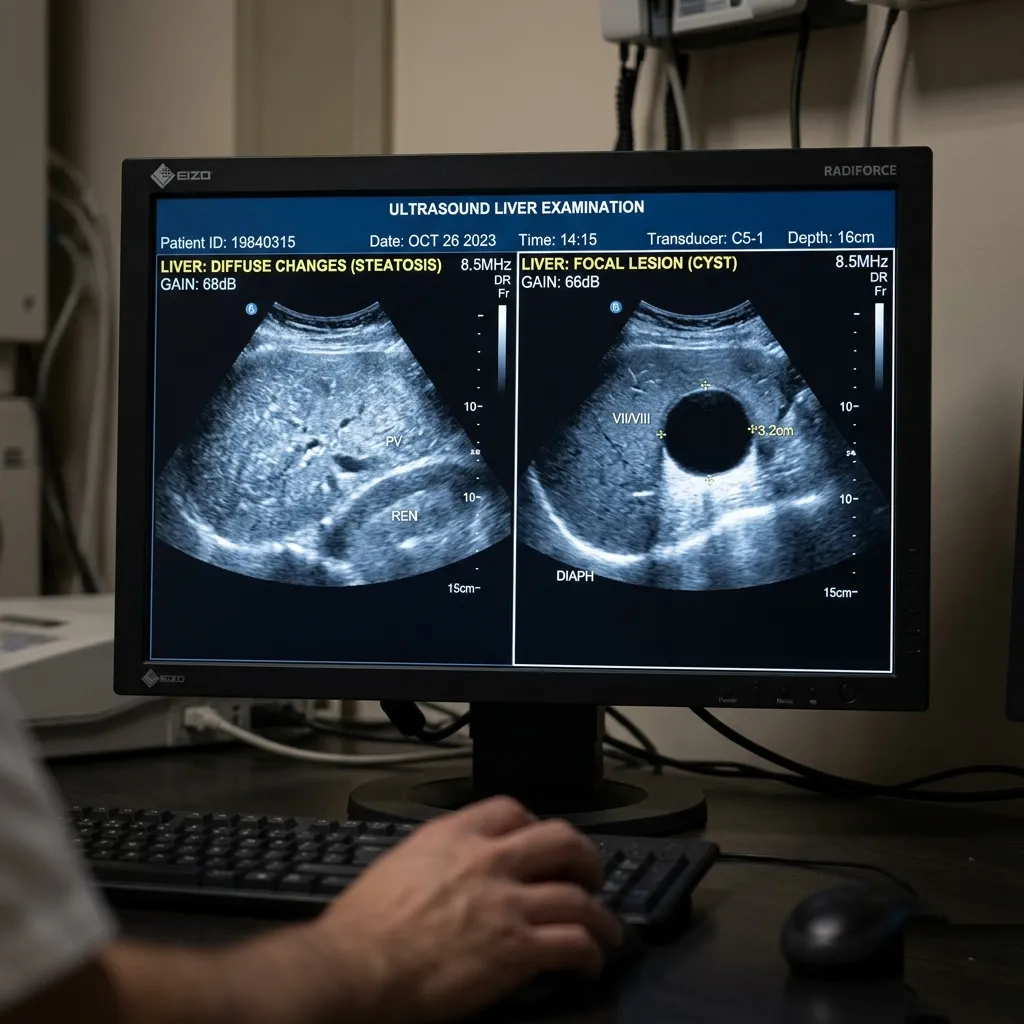
Radiology reports often describe abnormalities as diffuse or focal.
These words do not tell you the diagnosis by themselves, but they do tell you something important about the pattern.
What focal means
Focal usually means localized to one smaller area.
Examples might include:
- A focal liver lesion
- A focal area of lung opacity
- A focal thyroid nodule
The abnormality is being described as more concentrated or confined.
What diffuse means
Diffuse usually means spread across a broader area rather than limited to one spot.
Examples might include:
- Diffuse fatty liver change
- Diffuse lung haziness
- Diffuse thyroid enlargement
It suggests a more widespread pattern.
Why the distinction matters
Pattern helps shape the list of possible explanations.
A focal problem and a diffuse problem often lead doctors to think in different directions, even before they settle on the final diagnosis.
What these words do not mean
They do not automatically tell you whether something is dangerous or harmless.
They describe distribution, not severity by themselves.
How to read them calmly
If you see either word on a report, the useful question is:
- What is focal or diffuse?
- What does my doctor think that pattern points to?
That is more helpful than reacting to the adjective alone.
The bottom line
These terms are about pattern. Once you understand that, a lot of report language becomes less intimidating and easier to interpret in context.